Big Science, Small Grants: ESI Pilot Funding Powers Research Across Disciplines
By: Andy Flick, Evolutionary Studies scientific coordinator
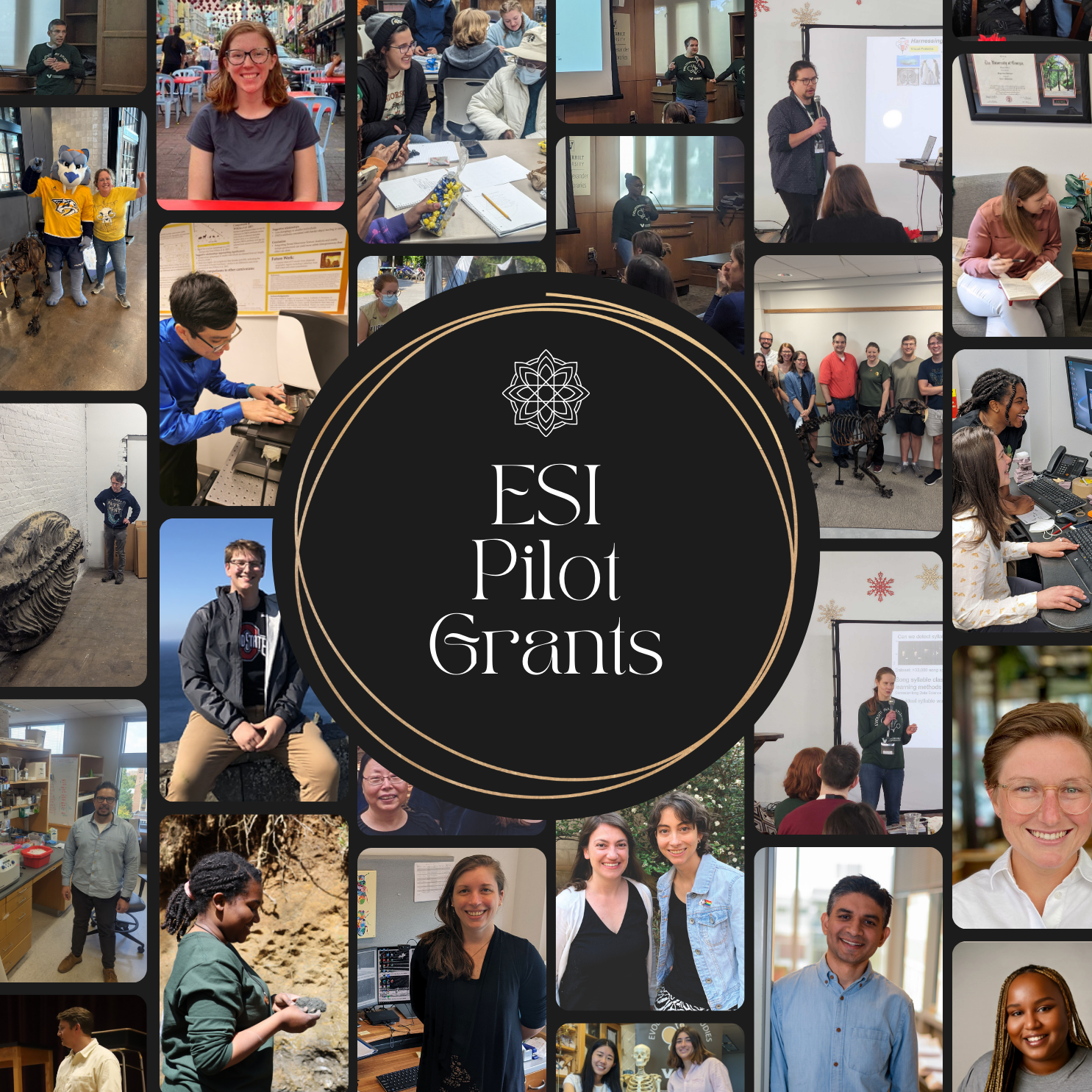
Since launching in 2021, the Evolutionary Studies Initiative’s pilot grant program has helped support more than thirty research teams across the departments of Biological Sciences, Earth and Environmental Science, Anthropology, and Pathology, Microbiology and Immunology. The premise is simple: a little funding, awarded fast, to help researchers try something new.
The results? In just a few short years, ESI pilot funding has contributed to at least 10 peer-reviewed publications across top journals like Science, PNAS, and Nature. These papers span an incredible range from whale cochlear evolution and cyanobacterial climate adaptation to stress physiology in humans and birdsong complexity.
Ancient Traits in Big Animals
From massive cats to modern whales and high-performance horses, ESI-supported projects are revealing how detailed anatomical and genetic traits shaped the evolution of large-bodied vertebrates. Larisa DeSantis and Justin Pardo-Judd analyzed the teeth of Smilodon to show that these saber-toothed cats were dietary generalists across a variety of environments and time periods (The Anatomical Record, 2025). In marine systems, Rachel Racicot along with ESI rockstar undergraduate Joyce Sanks reconstructed the inner ear anatomy of modern and fossil whales to investigate how high-frequency hearing evolved in deep-diving cetaceans (The Anatomical Record, 2024). Rounding out this group, Gianni Castiglione’s lab, with help from the Rokas Lab, identified a mutation in a muscle gene that played a role in accelerating horse evolution, evidence that a small molecular tweak could have helped shape speed and stamina in an iconic lineage (Science, 2025).
Evolutionary Mismatch and Health
How do organisms respond to environments their ancestors never encountered? These studies tackle the evolutionary costs of adaptation and the consequences of mismatch—whether through stress, inflammation, gene regulation, or immune overactivation. ESI’s first graduate student to receive a pilot grant, Audrey Arner, described gene–environment interactions in an Indigenous Malaysian population with the Lea Lab, showing how urbanization alters the expression of genes previously shaped by natural selection (Evolution, Medicine, and Public Health, 2024). Taiye Winful of the Benn Torres Lab led fieldwork in Lagos, Nigeria, linking chronic stress to elevated inflammation and epigenetic changes, offering a biocultural perspective on health (American Journal of Human Biology, 2024). And in a non-human model, Ann Tate’s lab revealed that overactivation of the immune system in flour beetles carries long-term reproductive and survival costs, highlighting the evolutionary balancing act between immunity and fitness (PLOS Pathogens, 2024).
Genomes in Motion: Microbial and Plant Innovation
From cyanobacteria to nematodes and flowering plants, several projects showcase the evolutionary plasticity of genomes in small, rapidly adapting systems. Megan Behringer and Ben Bratton used laboratory evolution to show how cyanobacteria develop seasonal responses to environmental pH—paralleling shifts seen in nature (PNAS, 2024). Kylie Jozwik, Maulik Patel, and colleagues identified a mitochondrial mutation in C. elegans that causes dysfunction, offering insights into mitochondrial diseases that affect humans (microPublication Biology, 2024). And in a study of plant organelle genomes, Sam Schaffner and Maulik Patel found that plants use gene conversion to manage mitochondrial heteroplasmy, demonstrating a subtle but powerful way evolution maintains genomic balance (PNAS, 2022).
Sound, Signal, and the Science of Communication
Not all science takes the form of experiments or fieldwork. Sometimes it takes the form of perspective. Kate Snyder co-authored a Nature News & Views article that explores how birds convey complex signals through simple songs, offering insights into how researchers are using machine learning to quantify patterns in animal communication (Nature, 2024). Her piece reminds us that the work supported by ESI isn’t just about data and discovery; it’s also about the questions we ask, the tools we build, and the meaning we find along the way.
These ten publications, and the rising wave behind them, show that early support can spark lasting impact. Several more pilot-funded projects have already resulted in preprints, with full publications expected in the year ahead. As new projects take shape, from microbiome evolution to urban ecology and climate-linked disease risk, the ESI pilot program remains a crucial driver of bold, interdisciplinary science. To help us keep this momentum going, consider supporting future rounds of pilot grants. A small investment today could fund the next breakthrough tomorrow.